
What 15 Years of Working Together can Teach You
“You need to stop talking to me because I’m thinking.”
This is not the kind of line that would go down particularly well in most offices.
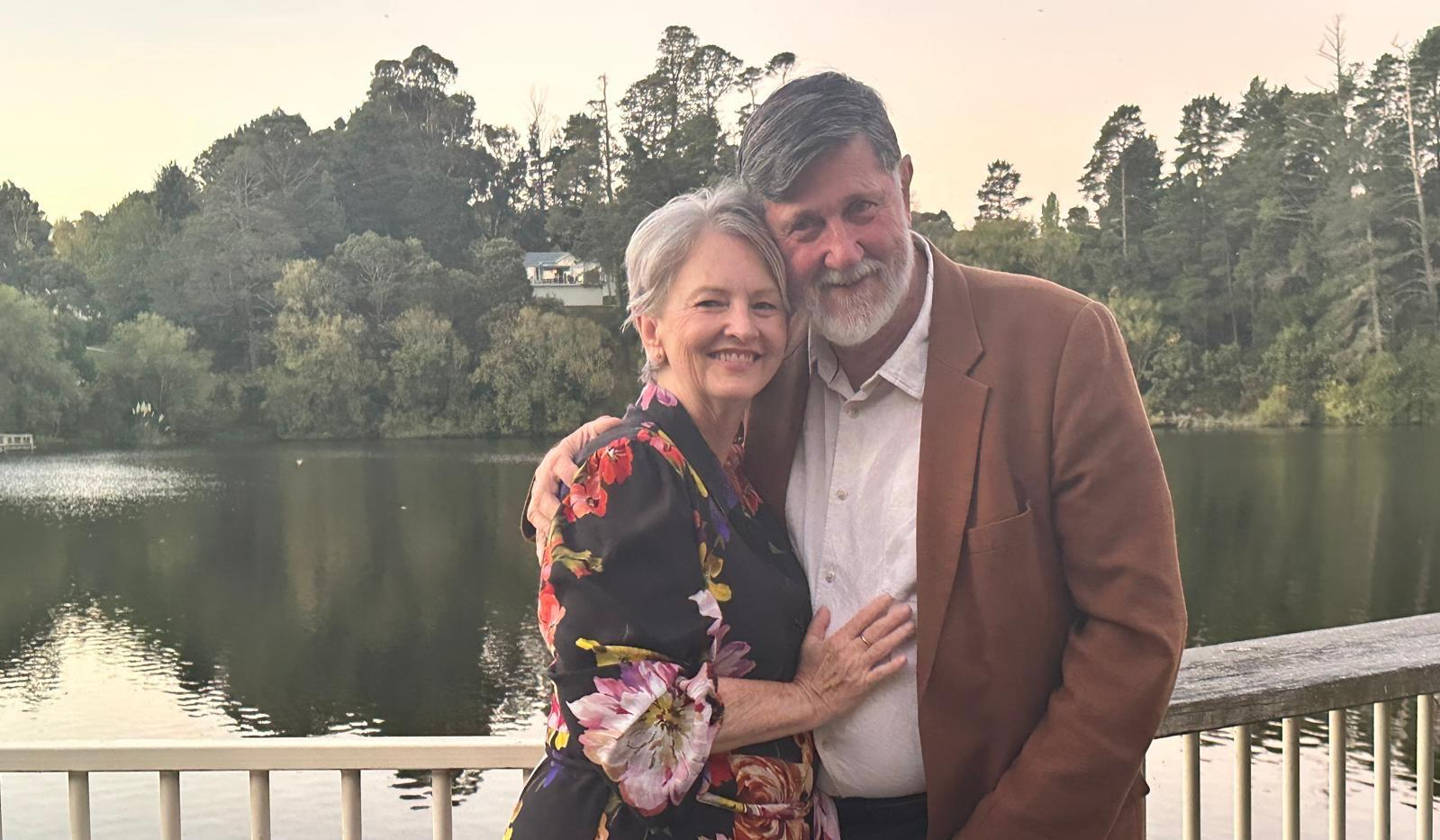
Yet when Lynda Ford OAM first began working with her husband Frank Wyatt, it was a fairly regular occurrence. Frank had spent more than two decades working independently from home. Lynda arrived with the habits of a collaborative workplace, casually asking questions of the person sitting next to her.
Unfortunately for her, the person sitting next to her was not a colleague. It was Frank.
“So, I had to kind of beat that out of him,” Lynda says, with the calm certainty of someone who clearly did.
That is the thing about Frank and Lynda. Their working relationship does not follow the polished script sometimes attributed to couples in business. It is not all seamless harmony and colour-coded responsibilities.
There is admiration, certainly. There is also friction, stubbornness, the occasional stare-down and a healthy willingness to make clear when the other person has made a poor decision.
It is funny and endearing to watch. It is also a reminder that working with your partner is not the same as working with a colleague in a conventional workplace.
Frank and Lynda have been together for more than two decades and have worked together for 15 years. Their work is spread across four connected entities: two private companies and two charities.
Enterprising Partnerships is Frank’s original consulting business, established more than 35 years ago. It now trades as Mosaic Intercultural Solutions, Lynda’s growing business focused on helping governments and communities build genuine connection across cultural difference.
Alongside the commercial work sits the iGen Foundation, their not-for-profit focused on social and economic inclusion through entrepreneurship, particularly with young people and migrant entrepreneurs. A second charitable entity exists to support fundraising for that work.
Having such a complex ecosystem helps explain why the traditional idea of one person being “in charge” does not quite hold up.
Frank is the confident talker and networker, yet it is Lynda’s knowledge of interculturalism that is driving their current focus. Frank describes her as an international expert in intercultural practice. Lynda is equally clear that Frank is an exceptional business mentor.
Their dynamic is not about one person leading while the other supports. It is about two highly experienced and accomplished people, both used to being good at what they do, finding the best path forward, sometimes through competing perspectives.
Frank is a doer, quick to pick up the phone, make the call and solve the problem. Lynda is more likely to think things through, consider the implications and work out the best response. Their differences are less about what they want to achieve than how they think they should get there. The friction often arises around the pace: quickly, like Frank, or more considered, like Lynda.
“I don’t see that as negative,” Frank says. “I actually see that as where we get our strength coming from because of our diversity.”
For them, difference creates tension, but it can also create innovation. It exposes new thinking and reveals the depth of the other person’s perspective. Many couples in business talk about the importance of complementing one another, but that can easily become code for staying in your lane and avoiding disagreement. Or, alternatively, one person shrinking while the other shines.
Frank and Lynda prefer to focus on getting better at working with their differences rather than fighting against them.
That does not mean it has always been easy.
Even during our conversation, there are moments of playful tension, where it is made clear who was right and who was wrong in a particular scenario, or where they reveal very different views. Lynda for example affectionately describes some of their home office exchanges as "yelling" whereas Frank is quick to question that descriptor.
Despite their differences, I get the impression that over the 15 years they have worked together, they have become less reactive to each other’s quirks and more adjusted to them. It also helps to have somewhere in the house where work is off the table.
For Frank and Lynda, that place is the kitchen.
Early on, they made it a neutral zone. It was where they could stop talking about work, stop arguing about a decision and focus instead on more ordinary things. What they were having for dinner, for example.
It sounds simple, but it was an important boundary. When your business partner is also your life partner, you cannot leave a difficult meeting, head home and reset separately. The conversation follows you down the hallway. It can spill into dinner, onto the couch and into whatever programme you had intended to watch together.
A neutral zone creates a deliberate pause. It gives the relationship somewhere to breathe.
They have also learnt the value of not doing everything together. At one stage, they knew many of the same people, attended many of the same meetings and heard much of each other’s work unfold in real time. It made the familiar question, “How was your day?” rather redundant.
Creating more distinct areas of focus has given them fresh perspective. It has also given them new things to discuss at the end of the day.
Frank and Lynda describe themselves as “meat and three veg” people, meaning ordinary and unexciting in comparison to some other couples. However, I think it is an overly modest description for a couple who have kickstarted the transformation of many people’s lives. However, perhaps the description is more apt when I consider that there is little performance about them, no polished version of a partnership for public eye that's different to the private one. For them, it is not about never disagreeing. It is about having enough respect to stay curious when you do and enough humour to survive the occasional sharp exchange.
Meat and three veg, perhaps. But with strong opinions and enough spark to keep things interesting.