
All their eggs in one basket
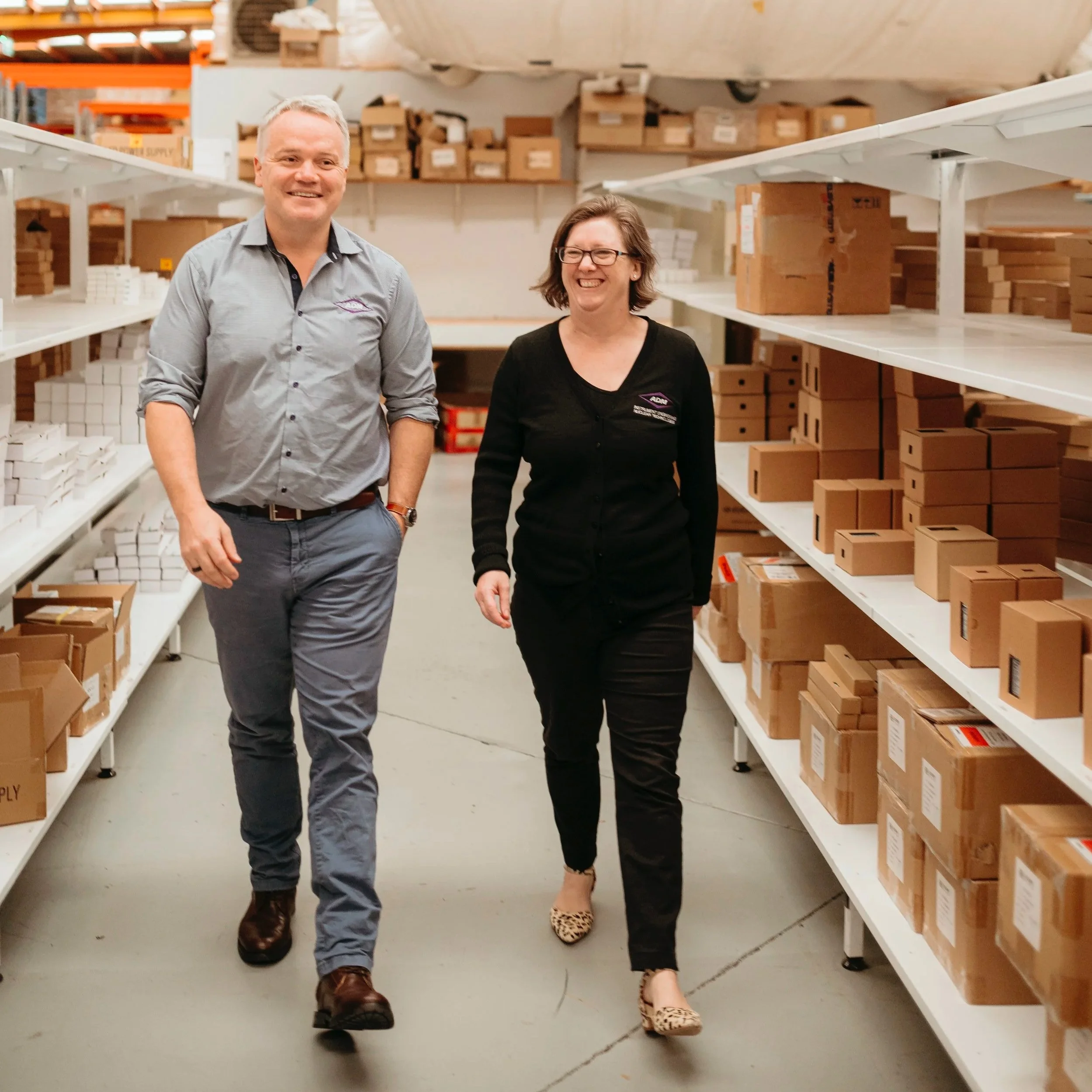
When I first met Kristin Brown, we were both taking part in a women’s leadership program.
Despite being diminutive like me, she had a presence that filled the room. I saw in her an immediate power and confidence that, if I am honest, I envied.
What I did not fully appreciate at the time was that Kristin had only recently taken the helm of her family’s business ADM. Founded by her father when she was in her first year at school, the company had been part of her life for as long as she could remember.
Kristin describes it as almost another sibling. The business was always present. Even some childhood holidays coincided with her father’s work trips, with her mother taking Kristin and her brother exploring while he attended to business.
Forty years later, ADM employs around 40 people and supplies technical products used to monitor and control industrial processes. Kristin is its CEO, although she is quick to play down the hierarchy.
“It’s a title,” she says.
In practice, she and her husband Jono divide responsibilities according to their strengths. Kristin tends to oversee finance, systems and process. Jono looks after areas including people, payroll, sales and one of the company’s specialist divisions. They move across the boundaries when needed.
Still, the title carries meaning.
Kristin is the founder’s daughter. She has the bloodline, the history and an instinctive knowledge of the business that cannot be learnt from a manual. She can spot an error without consciously looking for it because, as she explains, the system is her “happy place”.
She also doesn’t fit the conventional image of an industrial CEO.
Kristin is deeply creative. She once ran a floristry side-hustle and still paints the Christmas cards given to staff each year. Her leadership combines commercial discipline and attention to detail with creativity, care and a strong sense of what makes the business human.
There is another reversal in their story too.
Jono entered Kristin’s family business after building a successful career of his own at a university. As he became more senior, he found himself increasingly frustrated by the institution’s bureaucracy and the limits it placed on what he could change.
Leaving was not an easy decision. He had security, status and a defined-benefit retirement plan. Once he joined Kristin, almost every part of their financial life depended on the same company.
“We’re putting all our eggs in one basket,” he remembers thinking. “I’m giving up a career that’s going to be almost impossible to get back into.”
They were, as he puts it, “going all in on the business”.
In a technical and traditionally male industrial environment, the expected arrangement might have been for Jono to become the public leader while Kristin supported the family enterprise from behind the scenes.
That is not what happened.
Kristin is the CEO and successor. Jono has stepped into her world without needing full control of it. They sometimes disagree, but they do not seem to compete over authority.
When they prefer different paths, Jono often asks himself how much the decision really matters to him.
“I disagree with what you want, but it’s ultimately your call,” he will sometimes tell Kristin. “We’ll do what you want.”
At other times Kristin will remove herself from the decision entirely, although one provision is very clear for both of them: if you choose not to participate in the discussion, you cannot object afterwards.
Their differences have also influenced how they lead.
Kristin is inclined to find the flaw, test the risk and make sure every detail is right. Jono is generally more comfortable with uncertainty. When something goes wrong, she now tries to “channel the inner Jono” and remind herself that the situation may not be as catastrophic as it first appears.
The greater risk of working in one business has, however, brought an unexpected benefit: greater alignment.
When Kristin and Jono had separate high-pressure careers, one person’s opportunity could easily become the other person’s burden. Work travel meant someone else had to absorb more childcare. A demanding period for one career inevitably constrained the other.
Once they were working towards the same commercial goal, the equation changed.
There was no longer a debate about whose job was more important. Responsibilities could ebb and flow according to what the business and family needed that week. They could check their calendars in the morning, divide school runs and adjust work around their sons without seeking permission from two separate employers.
The financial rewards have also been significant. Jono says he now earns considerably more than he would have in his former career. The trade-off is less certainty, but he is clear that financially it has been “a very good decision”.
There is freedom too. Not freedom from work, necessarily, but freedom to shape how work fits into their lives.
Each year, Kristin and Jono make time for a trip to Hamilton Island, usually towards the end of the year. It is a genuine holiday, but it is also where they step out of the daily operation and think together. Kristin’s advice to other co-preneurial couples is to create time like this away from the operation to work on the business together.
“We have a really lovely, lovely, lovely holiday together,” Kristin says. “But we also talk business and strategy. What did we achieve this year? What do we want next year?”
For some, this blending of work and leisure could be viewed as a failure to establish boundaries. For Kristin and Jono, it appears to be part of the pleasure.
The business gives them something they enjoy imagining together. Their conversations are not simply about putting out fires. There is excitement in discussing what might come next and gratitude for the life the company has enabled them to create.
Working with family, however, also makes some conversations much harder.
When Kristin and Jono decided to commit fully to the company, her father remained managing director and still owned the shares. Trust and goodwill were not enough. They needed certainty about the future.
“We need something on paper. We need something written,” Kristin recalls Jono saying.
She also has a brother, employees depended on the company and the business needed to be capable of continuing if something happened to her father.
The conversation was difficult, but unavoidable. Their experience highlights one of the recurring traps in family businesses: the belief that close relationships make formal agreements unnecessary. In reality, those relationships often make paperwork more important and much harder to complete.
But as Jono maintains, worthwhile decisions are rarely the comfortable ones.
“Hard decisions are good decisions, and good decisions are hard decisions. If it’s easy, then there’s no decision to make.”
Kristin and Jono have concentrated their risk, but they have also aligned their ambitions. They have gained flexibility, financial reward and the ability to shape their family life around a shared purpose.
Most importantly, they seem to recognise the privilege of what they have.
All their eggs may be in one basket, but at least they are carrying it together.