
Beyond the 50/50 Game: The Partnership Behind That Sound Game
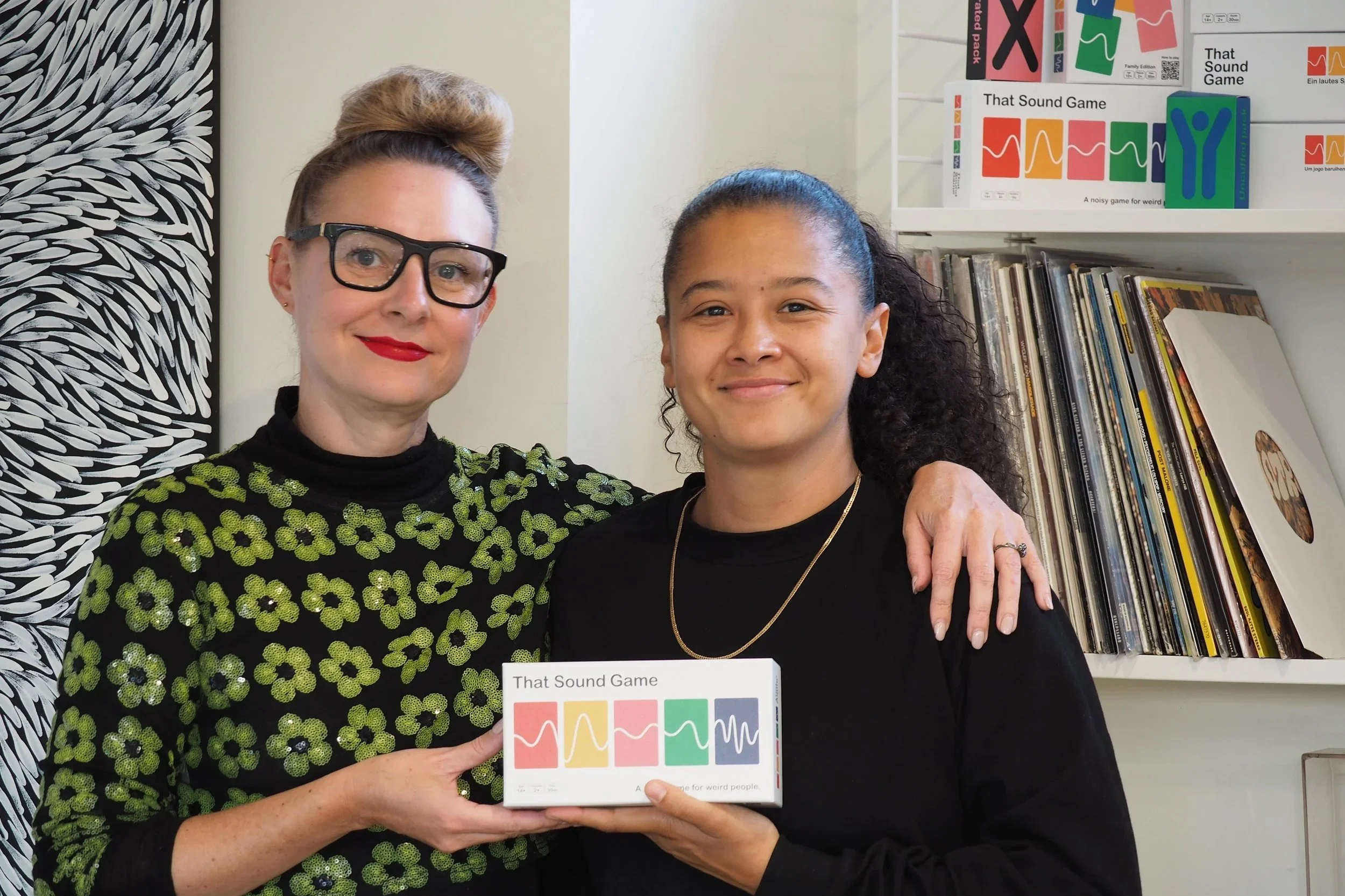
Walk into the board game aisle of Kmart and you’ll probably see That Sound Game on the shelf: a fast-paced party game in which players, with their hands behind their backs, have one minute to make their teammates guess as many answers as possible using only sounds and movements.
For Cam and Nat, that shelf position is still a slightly surreal outcome. The game was conceived during the pandemic, after Nat returned from a night with friends convinced she had an idea worth pursuing. She worked on the game in secret for 3 months, before bringing Cam on board, but neither had experience in the board game industry, so there was no obvious path into a market dominated by global brands.
Nat was told that Kickstarter (a crowdfunding platform) was the conventional path for independent game designers, however the model didn’t seem right. Most Kickstarter funded games are for more traditional board game audiences, but as a party game, she was confident That Sound Game would have wider appeal.
She talked to Cam about it, and they decided to trust their instincts. They self-funded the first print and put their faith in social media.
Then one influencer posted about the game.
“We woke up to 11 sales and I was like, ‘Oh, what’s going on?’” Nat recalls. “Within four hours, we’d sold out in the US. In four days, we sold out worldwide.”
That Sound Game has now sold hundreds of thousands of copies globally and has evolved into a growing publishing business called That Board Game Company, with Cam and Nat bringing their own games, and those of other Australian designers, to the global market.
It is a rare kind of success for an independent business.
Yet when I ask them what has enabled them to build it together, they do not talk first about product, distribution or marketing. They talk about the work of truly understanding one another, something that didn’t always come easy.
Like many couples who live and work together, Cam and Nat had begun by trying to make every part of their shared life feel equal. Equal contribution to the business. Equal housework. Equal sacrifice.
The goal seemed to be fairness, but what they got was friction.
Nat could feel she was carrying a disproportionate amount of the business. Cam could feel that she was taking on more of the domestic load. With both having a valid case.
“We were just completely at odds with one another,” Nat says.
The shift came when they stopped trying to divide every task neatly in half and started looking at the whole system they were building together. So, the question became less about who was doing more, or what was more important, and more about what would allow each of them to function at their best.
It sounds simple, but it requires a level of self-awareness and acceptance that many of us find difficult. You have to recognise that something which feels straightforward to you may be exhausting, overwhelming or simply a poor use of your partner’s particular gifts.
Nat sees the big picture and moves quickly through complexity. She can hold a remarkable number of threads in her head, make decisions at speed and write a complicated email to a distributor in five minutes. She loves being in the thick of chaos and is extremely good at it.
Cam brings skills Nat has little patience for: legal matters, contracts, compliance and governance. She also deals thoughtfully with team members, taking a diplomatic and empathic approach. When the business is moving quickly, and the next decision is already waiting, this type of approach can sometimes allude Nat.
Cam also jokes that “half of my job in this company is keeping Nat alive so that she can do her part in the company.”
It is a funny line, but it says a great deal about how they see their partnership.
Nat has ADHD, so by taking greater responsibility for the practical work of keeping the household moving, Cam helps create the conditions in which Nat can bring her best thinking to the company. In return, Nat’s speed, energy and commercial instinct have helped create a business with reach neither of them could have anticipated.
For Cam and Nat, taking traditional ideas of fairness out of the equation has not lowered expectations. It has allowed them to set better ones.
Their business works because they have learned to see their home, relationship, nervous systems, ambitions and work as part of one interconnected whole.
In doing so, they have moved beyond one of the limitations that couples, friends and family members who work together often place on themselves: the invisible ledger of who has contributed what.
Instead of keeping score, they have built a partnership that innately values what each person contributes. Together, that has become something pretty extraordinary.